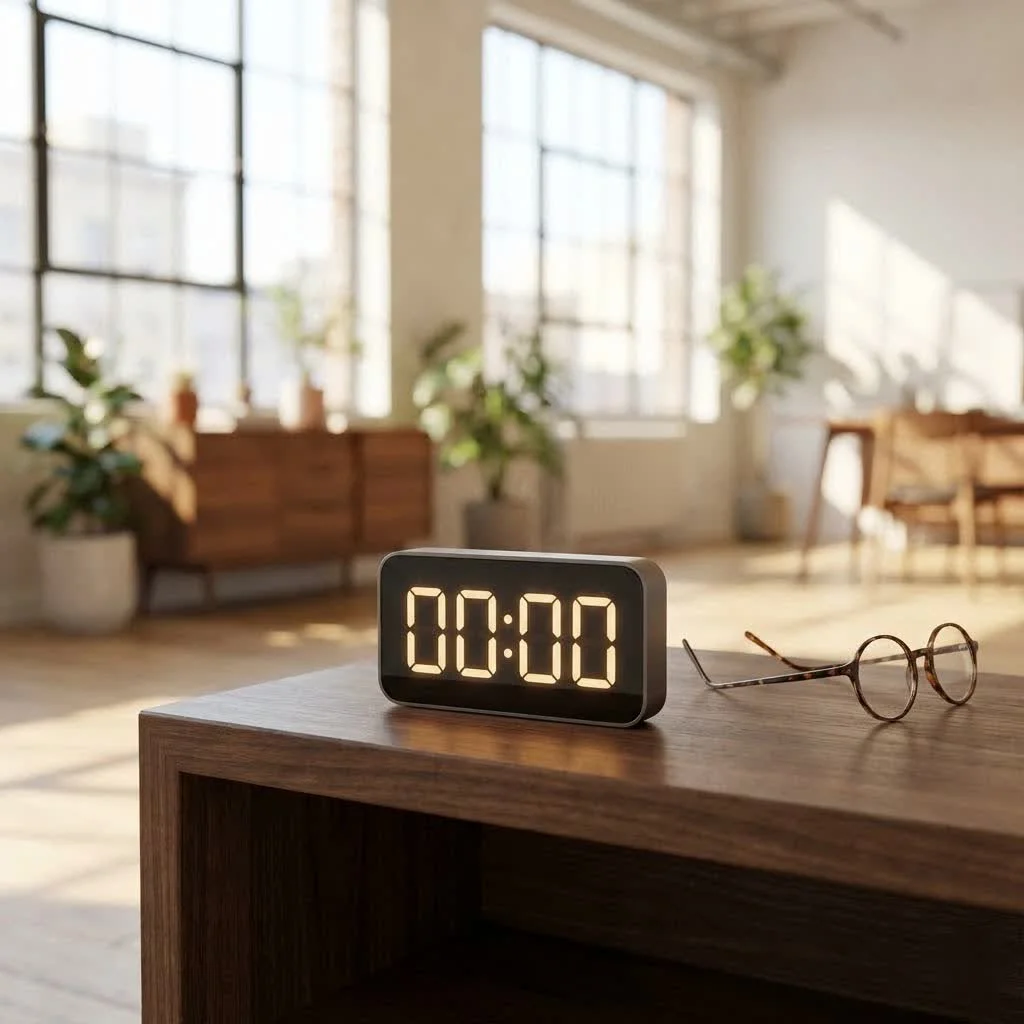
A digital timer with a clock is an electronic device that combines real-time clock functions with the ability to control electrical circuits based on programmed schedules. These devices leverage microcontrollers for superior accuracy and flexibility, typically featuring an LCD screen for displaying the current time and programming various timing functions like countdowns, count-ups, and scheduled on/off cycles. They are essential for automating daily routines, optimizing industrial processes, and enhancing home security.
What Exactly is a Digital Timer with a Clock?
At its heart, a digital timer with clock is an electronic device that combines the functions of a real-time clock with the ability to control electrical circuits based on programmed schedules. Unlike traditional mechanical timers that rely on gears and springs, digital timers leverage microcontrollers and semiconductor components for superior accuracy and flexibility. They typically feature an LCD screen that displays the current time and allows you to program various timing functions, such as countdowns, count-ups, and scheduled on/off cycles. For browse all digital timers articles on this site.
The core components that make these devices tick include a Real-Time Clock (RTC), which accurately keeps track of the current time, even during power outages thanks to a battery backup. A user-friendly interface, usually comprising a digital display and buttons, allows you to input your desired settings. Finally, a relay or output section connects to your electrical load, switching it on or off precisely as programmed. This synergy of components transforms a simple timer into an intelligent automation solution.
The Versatile World of Digital Timers with Clocks: Types You Should Know
The term “digital timer with clock” encompasses a broad range of devices, each tailored for specific needs and applications. Understanding these variations is key to choosing the right tool for the job.
Programmable Digital Timers
These are the most common type, allowing you to set specific “on” and “off” times. Many models offer daily, weekly, or even 7-day programming cycles, providing incredible flexibility. Imagine setting your outdoor lights to turn on at dusk and off at dawn, or your coffee maker to brew precisely when your alarm rings on weekdays, but stay off on weekends. Some even allow for multiple distinct programs throughout the day, accommodating complex schedules.
Astronomical Timers
A truly smart evolution of the programmable digital timer, astronomical timers are designed with built-in algorithms that calculate sunrise and sunset times based on your geographical location. This means they automatically adjust their schedules throughout the year, ensuring your outdoor lighting, for example, only operates when it’s actually dark, without you ever having to manually change settings for seasonal shifts. This is particularly useful for security lighting and holiday displays.
Multifunction & Sequential Digital Timers
|
Our Picks for the Best Digital Timer in 2026
As an Amazon Associate I earn from qualifying purchases.
|
||
| Num | Product | Action |
|---|---|---|
| 1 | Azosowo 2 Pack Digital Timer for Kids, Magnetic Kitchen Timers for Cooking, Egg, Teachers, Classroom, Study, Exercise, Oven Baking - AAA Battery Included |

|
| 2 | Allbean Magnetic Kitchen Timer for Cooking with Loud Alarm - Large LED Display Rotating Countdown Pomodoro Timer, Preset 5/15/25 Mins Easy for Seniors and Kids,for Baking Grilling Studying |
|
| 3 | GuDoQi Digital Hourglass Pomodoro Timer, Magnetic 1-99 Mins Adjustable Rechargeable Digital Countdown ADHD Timer, Mute/Low Volume/High Low Volume Modes for Work, Study, Back to School, Kitch, Black |
|
| 4 | 2 Pack Digital Kitchen Timer for Cooking Big Digits Loud Alarm Magnetic Backing Stand Cooking Timers for Baking White |
|
| 5 | Elegant Digital Kitchen Timer, Stainless Steel Model eT-23, Super Strong Magnetic Back, Loud Alarm, Large Display, Auto Memory, Auto Shut-Off by eTradewinds |
|
| 6 | Visual Kitchen Timer for Cooking,Chef Cooking Timers Clock with Loud Alarm,Timers for Classroom, Home and Study,Mechanical Desk Timer,No Batteries Required,Magnetic Back (Red) |
|
| 7 | VOCOO Digital Kitchen Timer with 7.8” Extra Large Display, Magnetic LED, with 3 Brightness, 4 Alarms and 3 Volume Levels, Battery Powered Countdown Count Up Timer for Cooking, Classroom, Home Gym |
|
| 8 | 6 Pack Multi-Function Electronic Timer, Learning Management, Suitable for Kitchen, Study, Work, Exercise Training, Outdoor Activities(not Including Battery) |
|
| 9 | VOCOO Digital Kitchen Timer - Magnetic Countdown Countup Timer with Large LED Display Volume Adjustable, Easy for Cooking and for Seniors and Kids to Use (Space Grey) |
|
| 10 | Easy to USE, Digital Kitchen Timer, Magnetic Timer,Tanmalan(Black,1 Pack) |
|
Venturing into more specialized territory, multifunction digital timers offer a variety of operational modes such as on-delay, off-delay, interval, and cyclic timing. These are often found in industrial settings where precise control over machinery and processes is paramount. Sequential digital timers take this a step further, capable of controlling multiple outputs in a specific, timed sequence, critical for automated production lines.
Installation Types: Plug-in vs. In-wall
Digital timers also come in different physical formats. Plug-in digital timers with clocks are incredibly user-friendly and portable. You simply plug the timer into an existing wall outlet, and then plug your appliance into the timer. They require no wiring and are perfect for lamps, small appliances, and seasonal decorations. In-wall digital timers with clocks, on the other hand, are designed to replace standard light switches or outlets. While they require some basic electrical wiring, they offer a clean, permanent, and integrated look, often used for built-in lighting or fan control.
As Dr. Elena Petrova, a veteran control systems engineer, aptly puts it, “The evolution of the digital timer with clock isn’t just about telling time; it’s about intelligent control, enabling unparalleled precision and adaptability across countless applications, from the simplest home task to the most intricate industrial sequence.”
Beyond the Kitchen: Everyday and Industrial Applications
The utility of a digital timer with clock extends far beyond simply timing an egg. These devices are indispensable tools for automation, energy management, and security in a multitude of environments.
Home Automation
At home, a digital timer with clock can be your personal assistant.
- Lighting Control: Automate indoor and outdoor lights for ambiance, convenience, and security. Imagine arriving home to a well-lit house, or garden lights turning on exactly as dusk settles.
- HVAC Systems: Program your heating and cooling to adjust temperatures based on your daily schedule, ensuring comfort when you’re home and saving energy when you’re not.
- Appliances: Set your slow cooker, electric kettle, or even a washing machine to start at a specific time.
- Garden & Irrigation: Ensure your plants get the right amount of water at optimal times, conserving water and promoting healthier growth.
- Pet Care: Automatically control aquarium lights or pet feeders.
Enhancing Security
A digital timer with clock is a simple yet effective deterrent against intruders. By programming lights and other devices to turn on and off at random or scheduled intervals while you’re away, you can simulate occupancy, making your home appear lived-in and less appealing to potential burglars.
Productivity & Personal Management
For personal use, these timers are excellent for focus and routine.
- Pomodoro Technique: Use a digital timer to manage focused work intervals and short breaks, boosting productivity.
- Medication Reminders: Set a reliable alarm to remind you or a loved one to take medication at specific times.
- Exercise & Cooking: Precision timing is crucial in many recipes and workout routines.
Industrial & Commercial Efficiency
In professional settings, the digital timer with clock is a workhorse, driving efficiency and safety.
- Machinery Operation: Control the on/off cycles of industrial machinery, reducing wear and tear, and optimizing production schedules.
- Process Control: Regulate critical steps in manufacturing processes, ensuring consistent quality and adherence to strict timelines.
- Building Automation: Manage HVAC, lighting, and security systems in commercial buildings based on occupancy schedules, leading to significant energy savings and operational efficiency.
- Motor Systems: Automate the power flow to motors in conveyor belts, pumps, or air conditioners, extending equipment life and reducing energy consumption.
Setting Up Your Digital Timer with Clock: A Step-by-Step Guide
Getting your digital timer with clock to work for you might seem daunting at first, but with a systematic approach, it’s quite straightforward. While specific steps can vary slightly by model, the core process remains consistent.
1. Resetting the Device
Before you begin, it’s often best to perform a full reset to clear any previous settings or glitches. Look for a small, recessed “Reset” button (you might need a paperclip or a thin pen to press it). Hold it down for a few seconds until the display clears or resets to a default time like 12:00 AM. For some models, holding down specific buttons simultaneously might achieve this.
2. Setting Current Time and Day
This is foundational for accurate scheduling.
- Plug It In: If battery-operated, ensure batteries are fresh. If plug-in, connect it to an outlet.
- Activate Clock Mode: Many timers have a “Clock” button. Press and hold it, or press it repeatedly until the time or day starts flashing.
- Adjust Time: Use “Hour” and “Minute” buttons (or up/down arrows) to set the current time. Pay close attention to AM/PM indicators if your timer uses a 12-hour format.
- Set Day: While still in clock mode (often by holding the “Clock” button), use the “Day” or “Week” button to select the current day of the week.
- Save: Release the “Clock” button or press it again to save the current time and day. Some timers automatically save after a few seconds of inactivity.
3. Programming ON/OFF Cycles
Now for the magic! This is where you tell your digital timer with clock what to do and when.
- Enter Program Mode: Press the “Program” (or “Prog”) button. The display will likely show “1 ON,” indicating you’re setting the first “on” event.
- Select Days: Use the “Day” or “Week” button to choose which days this program should run. Options often include individual days (Mon, Tue, etc.), weekdays only, weekends only, or all 7 days.
- Set ON Time: Use the “Hour” and “Minute” buttons to set the exact time you want your device to turn on.
- Confirm ON Time: Press “Program” again. The display will now likely show “1 OFF,” prompting you to set the corresponding “off” event.
- Set OFF Time: Select the same days (or different if your schedule requires) and set the time you want your device to turn off.
- Confirm OFF Time: Press “Program” to save this complete program.
4. Advanced Scheduling (Optional)
Many digital timers with clocks allow you to set multiple programs (e.g., “2 ON/OFF,” “3 ON/OFF,” up to 10 or even 20 programs). Simply continue pressing the “Program” button after saving a cycle to create additional schedules. Some advanced timers also feature a “Random” mode, which is great for security, turning lights on and off at slightly varied times within a window to simulate a living presence.
5. Activating Your Schedule
Once all your programs are set, you need to ensure the timer is in “Auto” or “Program” mode. Most timers have a “Manual” or “On/Off/Auto” button. Cycle through these options until “Auto” is displayed. This tells your digital timer with clock to follow its programmed schedule. Finally, ensure the device you’re controlling (e.g., a lamp) is switched to its “on” position, so the timer can cut or restore power as scheduled.
Troubleshooting Common Digital Timer with Clock Issues
Even the most reliable digital timer with clock can occasionally act up. Don’t fret! Many common problems have simple solutions.
1. Power Problems
- Timer Not Turning On: Check batteries. Are they dead or inserted incorrectly? Replace them or ensure proper polarity. For plug-in models, check the power cord for damage and try a different electrical outlet.
- Intermittent Power: Loose connections can cause this. Ensure the timer is securely plugged into the outlet and your appliance is firmly in the timer.
2. Display Malfunctions
- Dim, Blank, or Flickering Display: Often indicates low battery power. Replace batteries or ensure the unit is charging if it’s a plug-in model. If the backlight is out, consult your manual for backlight settings. Gently clean the screen with a soft cloth to remove dirt or smudges.
- Strange Characters: A full reset (as described in programming steps) can often clear internal glitches causing unusual display behavior.
3. Program Not Running as Expected
- Timer Not Activating/Deactivating: Double-check that the current time and day are set correctly. Verify that the timer is in “Auto” or “Program” mode, not “Manual On” or “Manual Off.” Review your programmed “on” and “off” times for any errors or overlaps.
- Timer Freezes/Doesn’t Count: This can be a software glitch. A reset and reprogramming often resolve this.
4. Alarm Issues
- Alarm Not Sounding: Ensure the alarm function is enabled in your settings. Check the volume level – it might be muted or set too low. A faulty internal speaker could be the culprit, which might require professional repair or replacement.
5. Unresponsive Buttons
- Buttons Not Responding: Sometimes, dust or debris can get lodged under the buttons. Try pressing them firmly multiple times. A can of compressed air can help dislodge obstructions. If buttons remain unresponsive, there might be internal damage, suggesting a need for repair or replacement.
the user manual is your best friend for specific model troubleshooting.
Choosing the Right Digital Timer with Clock for Your Needs
Selecting the ideal digital timer with clock means considering your specific requirements. It’s not a one-size-fits-all solution, but a tailored choice that aligns with how you plan to automate.
- Application: Will it be for simple home lighting, complex industrial machinery, or personal productivity? Home users might prioritize ease of programming and aesthetics, while industrial users need robust features like multiple functions, high current ratings, and reliable relay outputs.
- Programming Flexibility: How many on/off programs do you need? Do you require daily, weekly, or 7-day scheduling? For outdoor use, an astronomical timer can be a major upgrade.
- Installation: Do you prefer the simplicity of a plug-in model, or the integrated look of an in-wall timer?
- Features: Look for features like battery backup (to retain settings during power outages), clear LCD displays, 12/24-hour time format options, and even compatibility with smart home systems for voice control if that’s important to you.
- Durability and Reliability: Especially for industrial or outdoor use, ensure the timer has appropriate ingress protection (IP rating) and is built to withstand its operating environment.
Conclusion
The digital timer with clock is an indispensable tool in our journey toward a more efficient, secure, and convenient lifestyle. From meticulously managing your morning coffee routine to orchestrating complex industrial processes, these devices offer unparalleled precision and automation. With over a decade of firsthand experience, we at Kenws have seen how a well-chosen and properly utilized digital timer can transform daily tasks and operations, saving energy, enhancing security, and freeing up valuable time. We hope this guide empowers you to confidently select, program, and troubleshoot your digital timer, allowing you to optimize its capabilities and integrate seamless automation into your world. Embrace the power of precision timing, and let your digital timer work tirelessly for you!
Frequently Asked Questions
What is the main difference between a digital and mechanical timer?
The main difference is that digital timers use microcontrollers and semiconductor components for superior accuracy and flexibility, while mechanical timers rely on gears and springs. Digital timers typically feature an LCD screen for programming and displaying time, offering more precise control over schedules.
How do astronomical timers adjust for seasonal changes?
Astronomical timers feature built-in algorithms that calculate sunrise and sunset times based on your geographical location. This allows them to automatically adjust their schedules throughout the year, ensuring functions like outdoor lighting operate only when it's dark, without manual intervention.
Can a digital timer with a clock improve home security?
Yes, a digital timer with a clock can significantly enhance home security. By programming lights and other devices to turn on and off at random or scheduled intervals, you can simulate occupancy, making your home appear lived-in and deterring potential intruders.
What are common applications for digital timers in industrial settings?
In industrial settings, digital timers are crucial for machinery operation, process control, and building automation. They regulate critical steps in manufacturing, manage HVAC and lighting systems, and automate power flow to motors, leading to significant energy savings and operational efficiency.
What should I do if my digital timer's display is blank or flickering?
If your digital timer's display is blank or flickering, it often indicates low battery power. Replace the batteries or ensure the unit is charging if it's a plug-in model. A full reset of the device can also resolve internal glitches causing display issues.
Smart home that does not lock you in
Practical specs, not advice. Unsubscribe anytime.
I bought a digital timer to automate my coffee maker in the mornings, and it mostly works well. The accuracy is great, and it hasn’t drifted at all. However, I found the initial setup a bit confusing, especially trying to figure out the daylight saving time adjustment. It took me a while to get it right, but now that it’s programmed, it’s fine.
This guide really helped me understand the difference between basic countdown timers and the more advanced programmable ones. I ended up getting a model with an LCD screen, and it makes setting up my holiday lights so much easier. My only minor complaint is that the buttons are a little small for my fingers, but once it’s set, it works perfectly.
I’ve been using the BN-LINK digital timer for my grow lights, and it’s been a game-changer. The programming is super intuitive, and I love that I can set multiple on/off cycles throughout the day. It’s so much more reliable than the old mechanical timer I had, which always seemed to lose time. Definitely recommend for anyone needing precise scheduling.
I’m using a digital timer with a clock for my home security setup, specifically to turn lights on and off when I’m away. The microcontroller technology really shines here, providing consistent and reliable operation. It gives me peace of mind knowing my home looks occupied, and it was surprisingly easy to integrate into my existing system. A solid investment for automation.